Glass Sunroom
Built around the view
Expansive glass, daylight, and a strong connection to the yard, using an enclosure wall system like Seravue™ rather than conventional framed walls. It reads as a sunroom, distinct from the rest of the house.
Both can add valuable living space. The right choice depends on how you want the room to feel, function, and connect to the outdoors, not on which one is objectively better.
Both paths are designed and built by Valverax LLC • Licensed & Insured • Serving NC & SC
Built around the view
Expansive glass, daylight, and a strong connection to the yard, using an enclosure wall system like Seravue™ rather than conventional framed walls. It reads as a sunroom, distinct from the rest of the house.
Built around the room
Conventional framed exterior walls, standard residential windows, and a layout that behaves like any other room in the house, with the wall space and flexibility that comes with it.
A general guide to how each is typically designed, not a spec sheet. Your project's actual scope depends on your home and goals.
| Dimension | Glass Sunroom (Seravue™) | Traditional Room Addition |
|---|---|---|
| Primary design focus | Glass, daylight, outdoor connection | Room function and conventional living space |
| Amount of glass | Extensive | Standard residential window sizing |
| Wall construction | Enclosure wall/glazing system | Conventional framed walls |
| Window style | Full-panel glass systems | Standard residential windows |
| Connection to outdoors | Strong, near-panoramic views | Typical for an interior room of the house |
| Natural light | Abundant | Standard, window-dependent |
| Privacy | Less, more visibility in and out | More, solid walls on most sides |
| Furniture/wall flexibility | Limited wall space for mounting or storage | Full wall space for furniture, art, cabinetry |
| Seasonal vs. year-round use | Either, depending on Three-Season or All-Season design | Typically designed for year-round use |
| HVAC expectation | Occasional (Three-Season) or continuous if properly designed (All-Season) | Continuous, like the rest of the house |
| Architectural feel | A sunroom, distinct from the main house | An extension of the main house |
| Existing porch conversion | Very common | Possible, often a more extensive reconstruction |
| New construction | Yes | Yes |
| Typical homeowner goal | Views, daylight, connection to the yard | Functional living space that matches the rest of the house |
Seravue™ is Valverax's glass-centered sunroom and enclosure system. Seravue Three-Season is built for seasonal use and occasional heating or cooling; Seravue All-Season adds insulated glazing and a thermally improved envelope for year-round comfort without giving up the glass-room feel.
A traditional Valverax addition uses conventional residential construction, framed exterior walls, standard windows, and typical interior finishes, so the new room behaves like any other room in your house. It's a legitimate first choice for many projects, not a fallback for homeowners who don't fit a glass system.
It's a common assumption that glass sunrooms are seasonal and traditional additions are year-round. That's not accurate. Seravue™ All-Season is specifically designed for continuous heating and cooling, insulated glazing plus a thermally improved wall system, as part of a fully planned room envelope, roof, floor, air sealing, and HVAC included. Traditional additions are also commonly built as conditioned living space, but that's a function of how they're designed, not an automatic feature of either approach.
The real distinction is the architectural system and how you intend to use the room, not simply whether it has heating and cooling.
An existing covered porch is often a strong candidate for a Seravue™ Three-Season or All-Season enclosure, depending on the structure and how much of the existing envelope can be reused. A traditional addition starting from the same porch may involve a more extensive reconstruction, since it needs to become a fully framed room rather than an enclosed one. Which is realistic for your specific porch depends on an actual inspection, not a general rule.
Yes. Almost every structure includes some amount of framing, so "does it have framed walls?" isn't really the question that determines the brand. Valverax can design a custom structure that blends conventional framed sections with Seravue™ glass wall sections, for example, framed walls on the sides that need privacy or wall space, with a Seravue glass wall system on the side that faces the view.
The better question is what fundamentally defines the finished room. If the room is architecturally centered around glass and views, Seravue likely makes sense, even inside a larger custom structure. If the room behaves primarily like a conventional residential room with standard framed walls and windows, a traditional addition likely makes more sense, even if it includes some added windows for light.
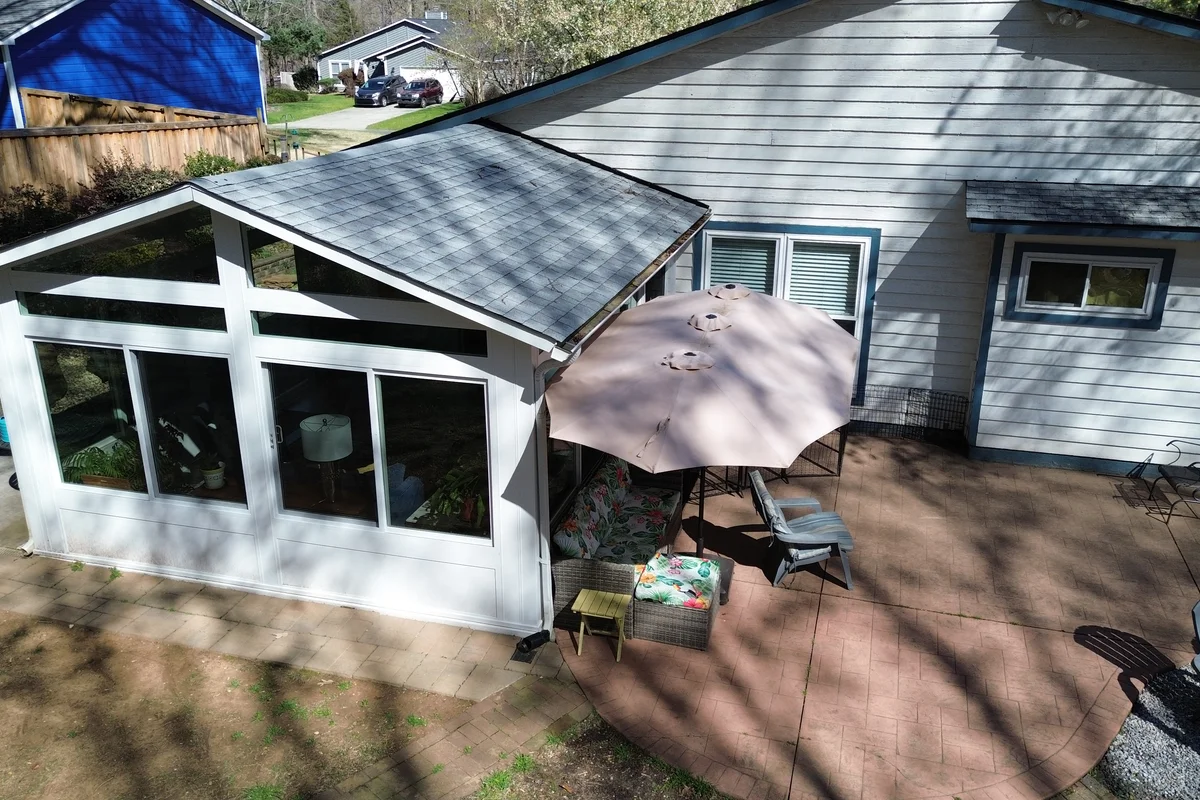
This type of insulated, all-season glass sunroom is now offered through Valverax as part of the Seravue™ All-Season program.
View This Project →
Representative Valverax addition work, conventional framed walls and standard residential windows and doors.
Explore Home Additions →The Find Your Best Fit diagnostic asks a few simple questions about how you want to use the space and can help distinguish between Sunleaf™, Seravue™ Three-Season, Seravue™ All-Season, a traditional addition, or a project that's genuinely worth a closer look from our team. It takes about two minutes, and you won't need to enter any contact information to see your result.
Not exactly. Both can be used year-round, but a four-season sunroom like Seravue All-Season is architecturally centered around glass and views, while a traditional addition is centered around conventional framed walls and standard residential windows. The difference is what defines the finished room, not just whether it's conditioned.
Yes, with Seravue All-Season, when insulated glass, a thermally improved wall system, and the full room envelope, roof, floor, air sealing, and HVAC, are all designed together. Insulated glass alone does not make a room all-season.
It can incorporate substantial glass, but at that point the enclosure system, not the framed walls, is what's really defining the room. Valverax can design a custom structure that blends conventional framing with Seravue glass wall sections where it makes sense.
Often, yes, depending on the existing structure and envelope. Some porches are strong candidates for Seravue Three-Season or All-Season; others may need more extensive work. Feasibility depends on an actual inspection, not a general rule.
A traditional addition, generally. Conventional framed walls give you more room for furniture, cabinetry, art, and storage. A glass-centered sunroom trades wall space for views and daylight.
No. Seravue is used for both new sunroom builds and existing porch conversions. The right fit depends on how you want to use the space, not just what you're starting with.
That's a legitimate custom project. Valverax can design a structure that combines conventional framed sections with Seravue glass wall sections. The question to ask isn't whether framing exists, almost every structure has some, it's what fundamentally defines the finished room.